


SUNDAY LOOK AHEAD
Alphabet reports Wednesday and gives the first hyperscaler capex answer to the Anthropic-versus-Meta question. Tesla reports the same day into a de-rating tape. The Fed meets July 29 with Jefferson having opened the hike door. The yen sits at multi-decade lows. Every catalyst this week measures whether the raise-not-beat template extends into the biggest earnings window of the year.
Last week the market stopped paying for beats.
TSMC (TSM) beat and raised capex 20 percent and got sold. ASML (ASML) raised guidance twice in one year and got sold. IBM (IBM) missed and crashed 25 percent in its worst day since 1987. UnitedHealth (UNH) raised guidance and got rewarded. Intuitive Surgical (ISRG) held guidance and got punished 11 percent. Goldman Sachs (GS) beat with equity underwriting fees up 130 percent and got rewarded. Beat is no longer the bar. Raise is.
The AI hardware trade shifted from de-grossing to de-rating. TSMC, ASML, and Japanese semiconductor names all sold off despite strong operating results, showing investors were repricing multiples rather than reacting to fundamentals.
Underneath the equity re-rating, CPI came in cool. PPI fell when it was supposed to be flat. Then Vice Chair Jefferson said Thursday he would back a rate hike if inflation stays sticky. The Iran waiver on new oil deals ended at midnight Thursday. The yen fell to a level Japan has not seen in four decades.
This week the raise-not-beat template gets its biggest tests. Alphabet reports Wednesday. Tesla reports Wednesday. Intel reports Thursday.
Here is what to watch.
The Seven Hottest IPOs On Wall Street’s 2026 Watchlist — FREE
The 2026 pipeline looks very different from years past.
Here’s what’s attached to some of the companies expected to headline the calendar:
• $24 billion in annualized revenue.
• 55% year-over-year revenue growth.
• $1.4+ billion in pre-tax profit.
• 200+ million monthly active users.
• Eight consecutive years of profitability.
Unlike many IPOs, those aren’t projections ten years out - they’re current figures tied to a select set of private companies preparing for public markets.
The Hyperscaler Capex Question Gets Its First Answer
Alphabet (GOOG) reports Wednesday after the close. It is the first hyperscaler to report since Anthropic signed a 20-year data center lease and Meta (META) signaled excess AI capacity two weeks ago. Two of the largest AI spenders cannot both be right about the same infrastructure cycle. Alphabet's capex guide is the first data point that names which read is winning.
Alphabet is the first hyperscaler to report, so management establishes the framework investors will use to judge Microsoft (MSFT), Meta, and Amazon (AMZN) over the following two weeks. Whatever Alphabet says about capex, cloud demand, and AI monetization becomes the template for the biggest earnings window of the year.
The bar is specific. If Alphabet raises 2026 capex guidance and points to accelerating demand, the Anthropic read wins. Physical AI infrastructure is a generational bet. TeraWulf (WULF), CoreWeave (CRWV), and Iren (IREN) all extend. If Alphabet holds capex flat or hints at capacity discipline, the Meta read wins. Excess capacity is real and the buildout is peaking.
Watch Signal
Watch Google Cloud growth against AWS's most recent print. If Cloud growth accelerates above 30 percent and capex guidance rises, the multiple rerates. If Cloud growth decelerates while capex holds, the market punishes the spend the way it punished TSMC.
The Robotaxi Question Meets a De-Rating Tape
Tesla (TSLA) reports Wednesday after the close alongside Alphabet. Two mega-cap prints in one afternoon. Both test the market's willingness to pay for AI-adjacent capex.
Tesla has already answered the delivery question. This report is about profitability and AI monetization. The market wants evidence that robotaxi and Optimus are becoming businesses rather than long-duration research projects.
Tesla is priced as an AI robotics company more than a car company. The market is currently punishing AI capex without revenue proof. Tesla has spent billions on FSD, robotaxi, and Optimus with limited near-term revenue attached. That is exactly the profile the tape rejected this week.
Earnings Signal
Watch robotaxi commentary specifically. Named cities and specific ride volumes signal genuine conversion. Vague "coming soon" language signals another quarter of AI spending without AI revenue. That distinction decides whether Tesla holds its multiple or joins the hardware de-rating.
Hidden in Tesla's Filing: A $12 Billion "Super Startup"
Pull up Tesla's most recent SEC filing. Page 5.
And you'll see a single line showing $12 billion in revenue from a brand-new "super startup" Elon Musk has been quietly incubating inside Tesla.
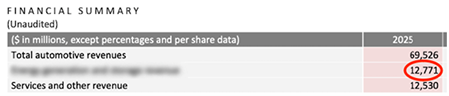
This new "super startup" has nothing to do with cars or robots or space or AI…
But it sits at the center of what Blackstone calls "a $23 trillion investment opportunity."
And on July 22, Elon is expected to pull back the curtain and reveal exactly what he's building.
But Adam O'Dell already knows… and he reveals it all in this urgent video.
The Last Hardware Beat-and-Raise Test
Intel (INTC) reports Thursday after the close. It arrives into a chip complex that just watched TSMC beat and raise and get sold. Intel is attempting to become both a leading chip designer and foundry. A stronger outlook would suggest the AI buildout is broadening beyond Nvidia (NVDA) and TSMC.
Texas Instruments (TXN) reports Tuesday. TXN sits at the industrial end of the semiconductor market, not the AI end. Its guide is the cleanest read on whether non-AI chip demand is recovering. If TXN raises and Intel raises in the same week, the chip complex broadens beyond TSMC and Nvidia.
Investor Signal
The chip layer needs three consecutive raise-guides to reverse the de-rating. TXN Tuesday. Intel Thursday. Then Amazon capex the following week. If any one of those disappoints, the hardware trade stays under pressure through the Fed meeting.
The Meeting Is Ten Days Away
The Fed meets July 29. A week ago that meeting was a hold consensus. It is not now.
Jefferson opened the hike door Thursday evening. Logan already floated a hike case. Waller published his clearest hike signal of the year last Monday. Warsh separated himself Wednesday, telling the Senate AI price increases are not structurally inflationary. Korea hiked Thursday to defend the won and offset imported inflation from the same Iran war Warsh called transitory.
The dot plot from June leaned toward one hike this year. That was before the Iran waiver ended and the yen fell to multi-decade lows. Both events transmit into inflation the Fed cannot look through.
Watch Signal
The two-year yield reprices immediately on the July 29 statement. If it rises 10 basis points or more, the market read the statement as hawkish. If it falls 10 basis points or more, dovish. The 30-year moves on Warsh's press conference tone. Watch both instruments through 3pm Wednesday July 29.
Middle East Conflict Lights Fuse on US Debt Bomb
America was already drowning in $38 trillion of debt, but the recent conflict in the Middle East just accelerated the timeline.
As oil spikes, a 100-year-old stock market signal that accurately predicted the 2008 and 2020 crashes is flashing a massive "Sell" on dozens of popular U.S. equities.
If you hold the wrong stocks when this debt crisis hits, it could wipe out years of gains.
Click here to see the 10 popular stocks to dump immediately
11780 US Highway 1, Palm Beach Gardens, FL 33408-3080 Would you like to edit your e-mail notification preferences or unsubscribe from our mailing list? Copyright © 2026 Weiss Ratings. All rights reserved.
The Rotation Gets Its Fundamental Test
Defense, industrial, and transportation companies all report this week, including Lockheed Martin (LMT), RTX (RTX), Northrop Grumman (NOC), Honeywell (HON), and Union Pacific (UNP). Together they test whether the industrial rotation has fundamental support rather than simply benefiting from money leaving technology. Norfolk Southern (NSC) surged in Friday's pre-market on M&A speculation and reports this week too.
General Motors (GM) reports Tuesday and gives the first read on whether the K-shaped consumer question hitting Delta (DAL) and PepsiCo (PEP) last week is showing up in auto demand. Insurance and financials names Chubb (CB), Capital One (COF), Marsh McLennan (MMC), and Blackstone (BK) all report and test whether credit quality is holding.
Earnings Signal
Watch defense capex commentary specifically. NATO commitments and Iran-driven order books both extend through 2028. If Lockheed and RTX raise, the defense trade continues even if chips fall further.
Ticker Revealed: Pre-IPO Access to the "Next Elon Musk" Company
We’ve found The Next Elon Musk… and what we believe to be the next Tesla.
It’s already racked up $26 billion in government contracts.
Peter Thiel just bet $1 Billion on it.
And you can get exposure — pre-IPO — through a 4-letter ticker symbol revealed in this free briefing.
Every catalyst this week measures whether the raise-not-beat template extends. Alphabet answers the hyperscaler capex question first. Tesla tests whether AI-adjacent capex without revenue still gets a premium. Intel and Texas Instruments test whether the chip complex broadens beyond TSMC and Nvidia. Industrials and defense test the rotation.
The Fed meets July 29. Jefferson opened the hike door. The yen sits at multi-decade lows. The Iran waiver has ended. The July 29 statement is genuinely two-sided for the first time this cycle.
Microsoft, Meta, Amazon, and Apple (AAPL) all report the week of July 29 into that Fed decision. This week is the setup. Next week is the resolution.
Last week the market stopped paying for beats. This week decides whether beat-and-raise gets rewarded again or whether raise-only is the new bar. What the market believes by Friday is what it carries into the Fed and the hyperscaler window at the same moment.
The Fed is two-sided. The AI hardware trade is de-rating. The yen is at multi-decade lows. The Iran waiver has ended. The data this week decides whether the market absorbs those four pressures or repositions ahead of them.