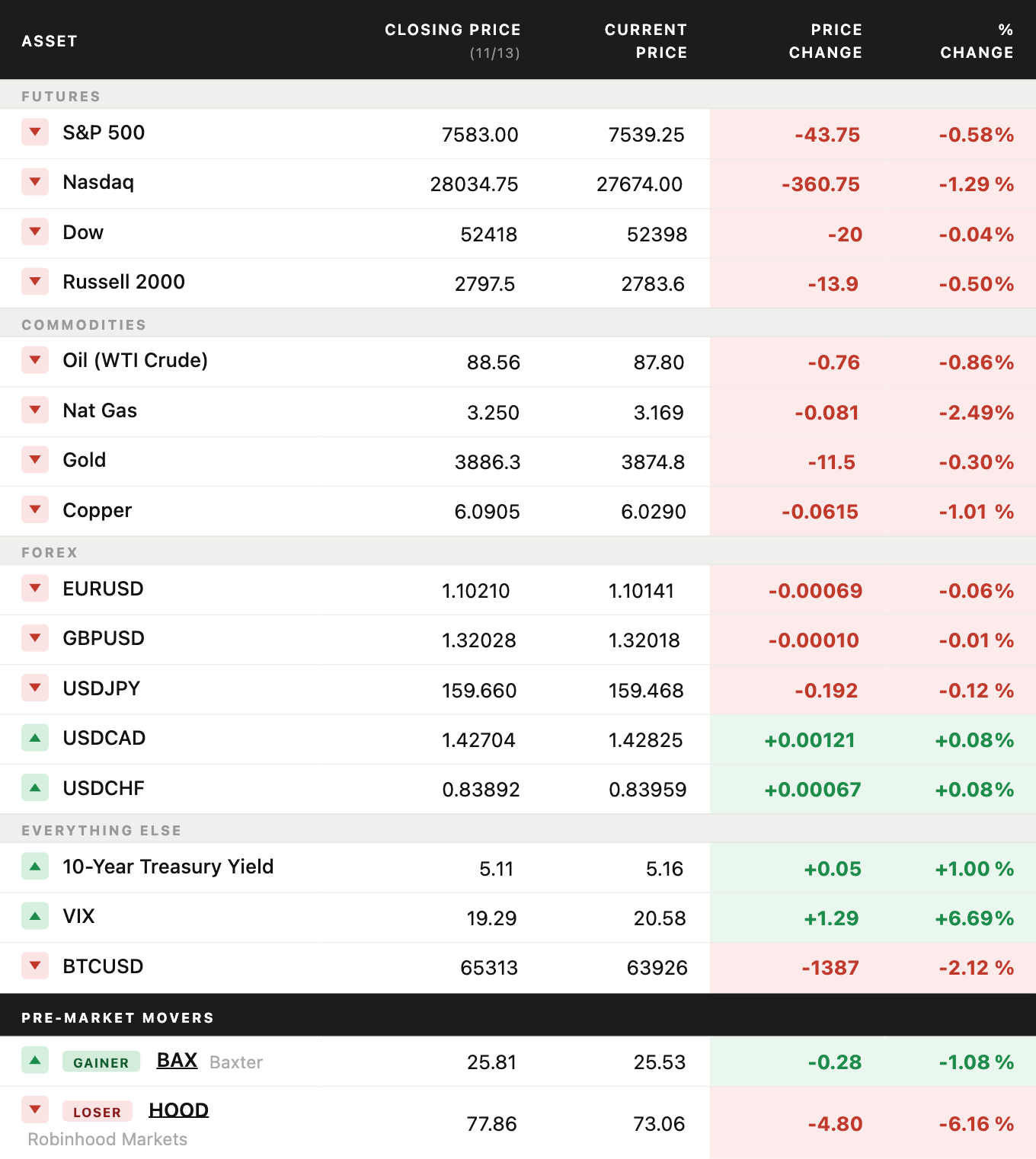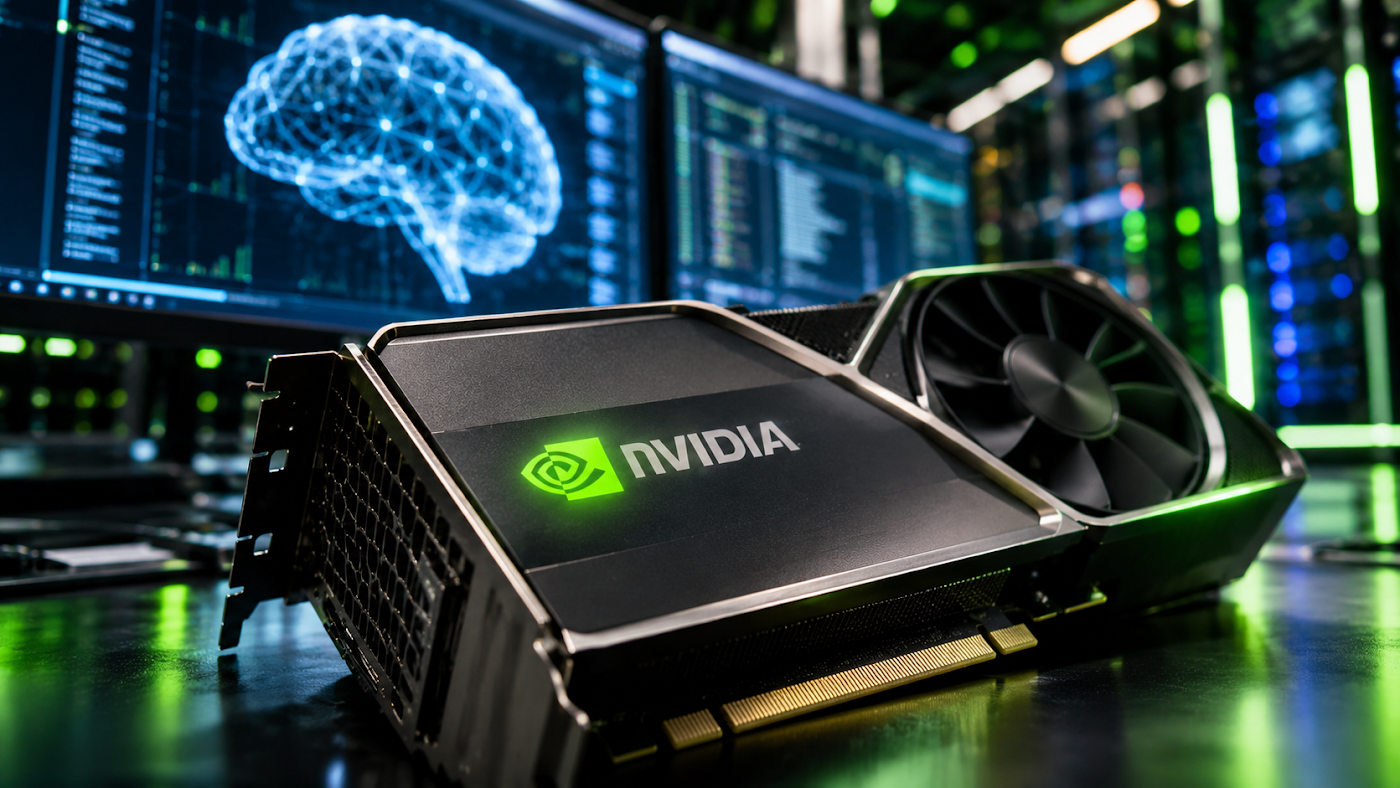
The Selling Found AI Without Help From YieldsAll three major U.S. indexes had their best week since August while chip stocks fell. Overnight, Nasdaq-100 futures dropped while Dow futures held flat. Chip names in Taipei, Seoul and Tokyo led Asia lower, and Taiwan fell the most. The 10-year closed Friday near 5.15% and held overnight. CME FedWatch puts a quarter-point hike in December near 94%. Odds of a half point fell to about 6% from about 11.5% Friday. On Kalshi, the bet on a hike bigger than a quarter point slipped to 9 cents from 11 on Sunday. Market Implication The weekend sorted assets by their AI exposure, not by how they trade on rates. Yields held and big-hike bets faded, yet Nasdaq futures still fell. That moves the risk from the Fed's pace to the profits and funding of one industry. If Nasdaq futures stay weak while the 10-year holds near 5.15%, the AI discount stands on its own. Musk walked away from the biggest IPO in history with a massive "war chest." Now he's spending it... He's already purchased a $40 billion AI firm. And a $1 billion turbine company. But to complete his monopoly on the space economy, he still needs to acquire three specific companies. Each is publicly traded and still under the radar. Get positioned before he moves... and you could see 100% overnight gains. Click here for the full story. WHAT ACTUALLY MOVED MARKETS The Chipmaker Fell Harder Than Its CustomerNvidia (NVDA) was indicated about 2.5% lower before the open, after a 12.75% loss last week. Taiwan Semiconductor closed down nearly 6% in Taipei, and its U.S. shares (TSM) were indicated about 4% lower. Nvidia reports Tuesday after the close, its first under interim CEO Colette Kress. It guided to $108 billion of sales, plus or minus 2%. The board is still picking a search firm. The weekend added a supplier question. Elon Musk wrote that many Nvidia supply deals were "a handshake with Jensen, not a written contract." That is his view; no supplier or filing backs it. Structural Setup The moves fit a market pricing Nvidia's leadership gap as a supply chain risk, though Taiwan's whole market fell too. Suppliers build plants and lines around Nvidia's deals, so doubt about those deals reaches their sales first. That makes Tuesday's call as big for suppliers as for Nvidia. If Kress cannot point to written, long-term supply deals, the suppliers' extra discount has a reason to stay. Bitcoin Fell While Its Funds Were ShutBitcoin dropped to about $62,000 late Saturday, its lowest since mid-July. It closed the week near $65,300, a sixth straight weekly loss. Spot bitcoin funds had already posted seven straight sessions of outflows and turned negative for 2026. The iShares Bitcoin Trust (IBIT) holds about $54 billion, against $64.2 billion put in since launch. As a group, its holders have put in more than the fund is now worth. The fund was indicated about 6% lower Monday and Strategy (MSTR) about 7%. Options lean the same way. On Deribit, the $60,000 put is now the largest single bet, at about $900 million. It passed the $100,000 call as traders closed bullish bets. Sector Read The weekend repriced bitcoin while its largest regulated buyers were locked out. Holders sitting on paper losses and a book tilted to puts leave fewer natural buyers on the way down. That makes fund flows a cleaner read on demand than the price. If the funds take in money with holders still behind, the weekend cleared leverage and kept its buyers. The Outage Has an Owner. The Bill Doesn't Yet.Friday's nationwide ground stop began at a remote FAA site, Transportation Secretary Sean Duffy said. L3Harris (LHX) had been installing a new router there. Officials have not decided whether the router or the install failed. L3Harris owns the network, and Duffy said he is "stuck" with it until a new one is built. Hewlett Packard Enterprise (HPE), which owns router maker Juniper, said the device "functioned as it was configured to by the installer." Airlines canceled nearly 16,000 flights in two days and have not put a cost on it. Yet the big carriers were indicated only 1% to 1.5% lower. L3Harris was down nearly 4% and HPE about 5% in thin early trading. Watch Signal The market is charging the network's owner and its router maker more than the airlines that lost the flights. Fault decides who pays for the outage, while airline losses look one-time. Until officials name a cause, both companies carry a discount. If the finding blames the install, HPE's discount has little left under it. AI's Biggest Commitments Sit Off the Balance SheetThe Fed's latest stability report put public debt tied to AI computing above $1.1 trillion. It came out after Friday's close. The bigger numbers are not debt at all. Signed leases that have not started top $1 trillion, undiscounted. Take-or-pay deals and resale guarantees add more than $2 trillion. The Fed noted that GPU makers "often provide a guaranteed residual value" on chips pledged as collateral. Nvidia's plan with six large investment firms to raise $500 billion of outside money has produced no deals, Bloomberg reported last week. Partners want a bigger backstop than its resale-value support on up to 25% of each deal. Credit has not flinched, with the high-yield spread at 3.20% on Nov. 12. The Read The risk in AI funding sits in guarantees and leases more than in today's spreads. A resale guarantee ties a chipmaker's balance sheet to the price of its own used chips. A falling chip market can then reach lenders through collateral as well as profits. If high-yield spreads stay near 3.20% while chip stocks fall, credit still treats AI as a stock market problem. Economic Data: Empire State manufacturing for November, forecast at 17.6 after 25.5. Retail sales Tuesday and Fed minutes Wednesday. Fed Speakers: New York's John Williams. Chair Kevin Warsh opens a Fed conference on productivity and jobs in San Francisco. Richmond's Tom Barkin speaks later. Earnings: Tyson Foods (TSN) and Aramark (ARMK), before the open. Overnight: Taiex -6.0% | Kospi -3.6% | Nikkei -2.4% | Shanghai -0.9% | Hang Seng +0.5% The weekend priced the AI trade from the outside in. Nvidia's chipmaker fell more than Nvidia, and bitcoin dropped with no ETF open. Rates stayed still through all of it.If Taiwan Semiconductor still trails Nvidia after Kress speaks, the doubt has moved past one CEO. AI Found the Target. AI Designed the Drug. Now It's in Phase III.For years, AI drug discovery had a problem. Plenty of models. Very few medicines.
That's changing. One company says AI identified the biological target and then designed the molecule to hit it. In September, the first patient in its Phase III trial was dosed.
It isn't alone. A second AI-engineered medicine is in Phase III, and Big Pharma is now paying for the technology.
We profiled the 5 companies pushing AI into real drug development in a new FREE Special Report: AI Moves Into the Biotech Lab.
We'll text it straight to your phone. Get the Free Report by Text → |
|