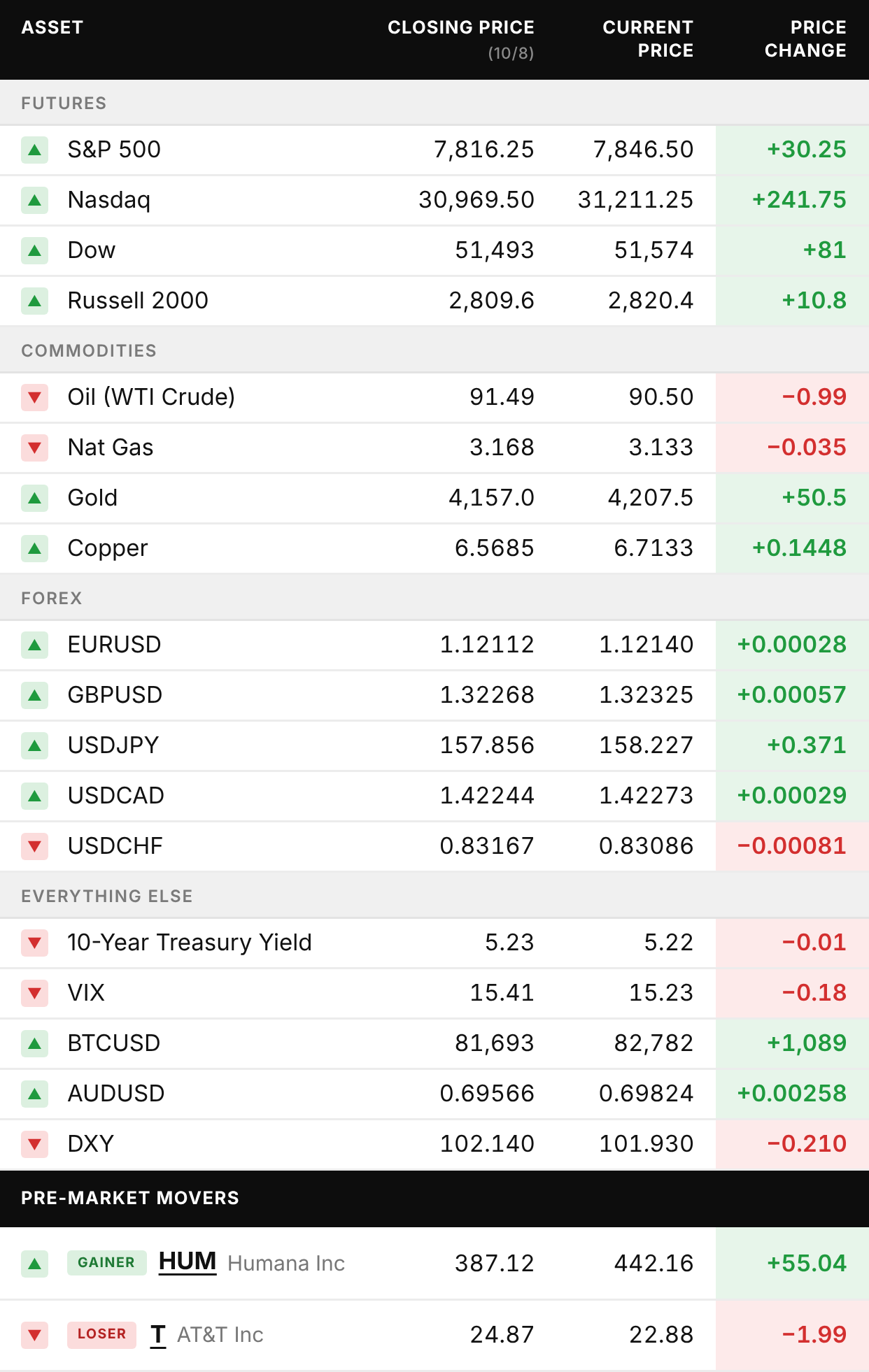
Chips Fell 3.4%. The Rest of the Market Mostly Held.Thursday's selling was deep and narrow. The S&P 500 slipped 0.5% to 7,765.36, and the Nasdaq fell 1.3%. The Dow and Russell 2000 edged higher. The PHLX Semiconductor Index lost about 3.4%. Then bonds turned. The Treasury sold $22 billion of 30-year bonds at 5.618%, the highest stop-out since August 2000. The 10-year closed near 5.23%, down about 5 basis points, on a day Brent gained about 4%. Early Friday, Brent eased 1.6% to $102.57, gold rose 1.5% and bitcoin held near $82,500. Market Implication Chips fell on a day long yields dropped, which makes a pure rate story hard to tell. Most of the damage stayed inside the AI supply chain. Today shows whether the futures bounce reaches those names or only the index. The MarketBeat Analyst Team Just Released Their Top 5 Stocks to Buy Now — Fully Updated for October.Every stock on this list carries a high consensus rating across Wall Street and has passed our strict criteria: - Robust analyst coverage
- Market cap of $5 billion or more
- Full bull and bear case built from MarketBeat data and recent news
Today, you can get the complete list absolutely FREE. Send My Free Report WHAT ACTUALLY MOVED MARKETS OpenAI's $20 Billion Gap Is Partly a Definition. Oracle Lost $23 Billion Anyway.OpenAI told investors its September annualized revenue was almost $50 billion, a person familiar said. Late-September reports had put it near $70 billion. A source familiar with the documents told CNN the higher figure likely reflected efforts to compare OpenAI with Anthropic, which counts sales through cloud partners. OpenAI leaves those out. The reports did not say how much of the gap that difference explains. The tape did not wait for the footnote. Oracle (ORCL) was down about 1.1% just after noon. It then broke lower and closed down 5.6%, about $23 billion of market value. CoreWeave (CRWV) fell 7.8%, but about 60% of that came before the report circulated. In Sydney, Nvidia-backed data-center developer Firmus withdrew its planned listing, citing market volatility. Structural Setup The number that moved was a private company's run rate, not a listed company's guidance. CoreWeave's filings put its OpenAI contracts at up to $22.4 billion, about half its market value, and the filings make those payments subject to termination. Oracle has not put a dollar figure on its exposure. Until it does, the market is pricing concentration without a denominator. The Same Airwaves, a Second Buyer. The Carriers Lost $38 Billion.After Thursday's close, Grain Management agreed to sell its nationwide 800 MHz spectrum to SpaceX (SPCX). Grain bought those airwaves from T-Mobile in August for $2.9 billion in cash plus its own 600 MHz licenses. No price was disclosed. The Wall Street Journal, citing people familiar, put it near $8 billion in cash. The deal needs FCC approval. By about 5:20 a.m. in thin trading, AT&T was down 7.4%, Verizon 6.8% and T-Mobile 6.9%. That is about $38.5 billion of market value, close to five times the reported price. SpaceX traded 3.9% higher. Tower owners went the other way in tiny volume: American Tower rose about 5.9% and SBA Communications about 4.8%. Sector Read The market split network owners from site owners. SpaceX agreed to buy coverage spectrum most phones already support. A Verizon spokesman called it "empty airwaves" without a network. One reading of the tower bid: any ground network SpaceX builds would need towers. A Stock Pick Without a "Why" Is Just a Guess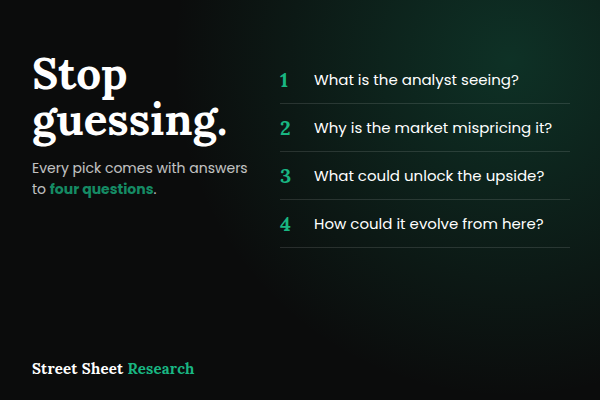
Do you know whether to hold or walk away when a stock drops? Most investors don't, because they never knew why they bought it. Every Street Sheet Research idea comes from a top-ranked Wall Street analyst and answers four questions: What is the analyst seeing? Why may the market be mispricing it? What could unlock the upside? How could it evolve from here? Your first year is $99, with a 90-day money-back guarantee. Start Investing With Conviction → Sponsored by The Street Sheet. Upside potential reflects analyst price targets, which are estimates and may not be realized. Past performance is not indicative of future results. Investing involves risk, including loss of principal. Not personalized investment advice. Membership renews at the then-current list price after year one unless canceled. The Pledge Removed a Date. Most of Oil's Premium Stayed.President Trump posted Thursday that the U.S. will not attack Iran before the Nov. 3 midterms. The blockade stays. Brent had touched $105.91 before the post and still held about 72% of its gain that afternoon. The flow data conflict. The president said 22 million barrels moved through Hormuz in one night. Kpler data, cited by Reuters, showed crude transits falling sharply and the vessel count at its lowest since July 23. Hurricane Isaias is the nearer test. About 63% of Gulf of Mexico oil output was shut in Thursday, according to federal offshore data reported by Reuters. Landfall is expected late Friday or early Saturday. A Polymarket contract on the blockade lifting by Oct. 31 slipped to 19.5 cents from 20.5 cents. Watch Signal The storm is the part of the premium with an end date. The strait is the part without one. If Brent holds above $100 after Isaias makes landfall, crude is mostly pricing Hormuz. Bitcoin Held $80,000. Ether Took the Hit.About $1.19 billion of crypto positions were liquidated over 24 hours, mostly longs, CoinDesk reported. CoinDesk put ether's liquidations near $1.2 million per $1 billion of market value. Bitcoin's were about $180,000. That is nearly six times the damage. Bitcoin bottomed near $80,315 Thursday and was back near $82,500 early Friday. Fund money did not follow the bounce. U.S. spot bitcoin ETFs had net outflows of $485 million Wednesday and $244 million Thursday, Farside data show. Ether funds have posted outflows for eight straight sessions, according to Farside data cited by Cointelegraph. The Read The bounce came after leverage was cleared, not after new money arrived. Weekly bitcoin and ether options expire today. A rebound that holds through expiry while outflows continue would mean the flush did the work. One that fades points back to the funds. Economic Data: University of Michigan Consumer Sentiment Fed Speakers: Kansas City's Jeffrey Schmid, 9:30 a.m. Boston's Susan Collins, 4 p.m. Earnings: Delta Air Lines (DAL) cut its 2026 adjusted profit forecast to $5.10 to $5.60 a share from $6.50 to $7.50 after third-quarter results missed estimates. It expects a fuel bill about $6 billion higher this year. Shares fell about 3% before the open. Overnight: The Hang Seng rose 1.8%, and European stocks opened higher. Oracle lost $23 billion on the day a private company's run rate was reported. The carriers lost $38 billion after a deal for airwaves with no network yet. Both moves came before the disclosure that would settle them. The cleanest test is today's regular session. If Oracle stays behind the Nasdaq-100 and the carriers hold their losses while futures rise, investors are repricing concentration. If both snap back, Thursday traded the headlines. 3 Stocks at a Major Turning PointSomething unusual is happening beneath the surface of three widely followed stocks.
In each case, the fundamentals are saying one thing... while institutional activity, management signals or the options market are saying something else. That kind of disagreement can matter. Because when the evidence stops lining up, the next move in the story often comes down to a handful of signals most investors never think to watch. Our new FREE Market Tell Special Report breaks down three of these situations, and shows you exactly what we’re watching next. Get the Free Report: 3 Stocks at a Major Turning Point → |
|