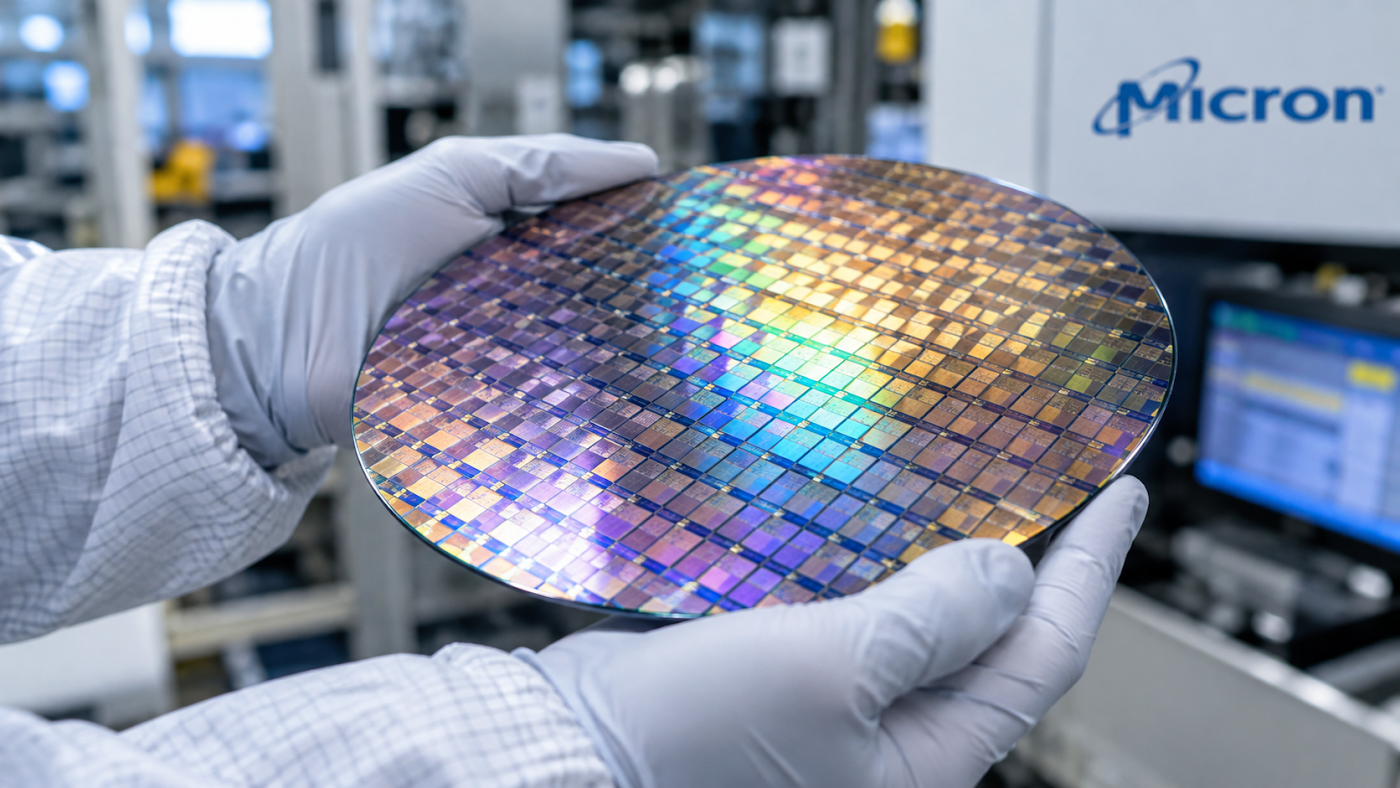
A Flat Index Hid Selling With AddressesThe S&P 500 closed at 7,807.79, down 0.05%. The Dow rose 196 points, or 0.4%. The Nasdaq fell 0.4%, and the Russell 2000 lost 0.4%. The VIX closed at 15.21, up from Friday but down from about 15.5 early Monday. The flat close was a split, not a calm. Eight of 11 S&P 500 sectors finished higher. The losses landed on tech and consumer discretionary, and on memory chipmakers hardest. Bonds were closed for Columbus Day, with the 10-year Treasury yield last at 5.24%. Brent slipped to $102.39 after futures reopened Sunday night, then traded near $107 during the session. Bitcoin eased about 1% to near $83,000 late in the day. TQ Trade Implication The index absorbed a targeted selloff without breaking, and the VIX gave back about half its early jump. Tuesday brings back the force that hits everything at once. Bonds reopen the same morning JPMorgan reports. 7 Stocks That Could Become the Market’s Next GiantsApple, Google, Tesla… Sure, they’re household names now, but these companies and the other members of the original Magnificent 7 didn’t start out obvious. They earned their place over time. Our analysts believe the next generation of market leaders is forming now… And we’ve identified the 7 companies that fit the “Magnificent” pattern. You can see the full list for free today Don’t wait until everyone’s talking about them. Get Your Free Report Today. Seoul Sold Memory First. New York Kept Selling.The Kospi fell 3.65% on Monday as Samsung Electronics lost 4.39% and SK hynix 4.52%. Micron (MU) was indicated about 2% lower before the U.S. open. It closed down 3.9%. China's ChangXin Memory Technologies said over the weekend it had made progress on a denser memory-cell design. Samsung and SK hynix are pursuing the same approach. CXMT's president said it aims to launch a server memory product on the design by the end of 2026, the South China Morning Post reported. The shares fell after that news, which doesn't make it the only reason. Analysts in Seoul also cited the end of Samsung's buyback and the near-end of SK hynix's. Foreign investors were net sellers of Korean stocks. The won still hit its strongest level in two years, which local reports credited to exporters selling dollars. The currency and the chip stocks told different stories. TQ Edge Setup The market marked down incumbents partly over a product CXMT has not shipped. The narrower test is capacity. A denser design matters only if CXMT can buy the tools to build it in volume. ASML reports Wednesday, and its China share of system sales is the cleanest public read on that. A rising share gives the end-2026 target weight. A falling one makes Monday's markdown look early. Crude Added a War Premium. The Yemen Contract Sat Still.Strikes claimed by the Houthis hit Riyadh's King Khalid International Airport on consecutive days, killing 13 people Saturday by later tallies. Saudi authorities first said 12. Asked Saturday whether the U.S. would join Saudi strikes, President Trump said: "We may. We're going to look at it." No decision has been announced. Crude climbed. Brent traded as high as $107.30, above last week’s $105.91 peak and its highest since Sept. 28. WTI reached about $93.80. Both rose about 2%. This morning's open question was Sohar, the Oman anchorage where Gulf crude moves to supertankers outside the strait. A drone hit a tanker there Sunday. Gulf of Oman supertanker charters had already topped $1 million a day last week. The charter market hadn't printed a post-attack rate by the close. Tanker owners' stocks rose in the same session. DHT Holdings (DHT) rose 6.4% and Frontline (FRO) 5.5%. Both touched 52-week highs. Event traders barely moved. Polymarket's contract on the U.S.-Yemen ceasefire holding through Oct. 31 rose to 80.5 cents early Monday from 76.5 cents Sunday afternoon. It slipped to about 79.5 cents by about 8 a.m. and held there into the afternoon as crude rallied. The contract fails only on a direct U.S. air or missile strike on Yemen. Backing Saudi strikes doesn't count. Traders are pricing roughly a one-in-five chance of a direct U.S. strike before November. It is a thin market, with less than $90,000 traded on the Oct. 31 line. TQ Edge Setup Both markets price a war that keeps going without a direct U.S. role. A shorter Oct. 15 line, near 94 cents, resolves Thursday. The other test is the first Gulf of Oman charter after Sohar. A rate well above last week's $1 million would mean the bypass is starting to price like Hormuz. The Banks Report From a CorrectionThe 10-year yield sits near its highest since 2002. Bank stocks haven't treated that as good news. The KBW Nasdaq Bank Index is down more than 14% from its August peak, Yahoo Finance reported. Over the past month, Goldman Sachs (GS) lost 12% and Bank of America (BAC) 13%. Analysts expect third-quarter results to fall short of a bumper second quarter, with fewer large deals, Reuters reported. Some big borrowers have been moving back to banks. In late August, Catalent completed a swap of a $4.2 billion direct-lender loan for a roughly $4.1 billion bank-syndicated term loan. Stressed first-lien loans held by business development companies rose 92% in the first half, to $47 billion, PitchBook LCD data show. If the strongest borrowers refinance with banks, private funds keep the weaker ones. AI is competing for the same money. Last week's Fed minutes said a few officials cited "increased expectations for AI-related borrowing" among the reasons long yields rose. SpaceX is seeking about $40 billion for chips, people familiar said. A Blue Owl joint venture paid 8.875% on five-year notes for a Virginia data center. On Monday the demand side said it out loud. Broadcom (AVGO) Chief Executive Hock Tan said in Singapore that capital "might be the biggest constraint" on the AI buildout. JPMorgan (JPM) reports Tuesday before the open, along with Goldman, Wells Fargo (WFC) and Citigroup (C). Bank of America and Morgan Stanley (MS) follow Wednesday. TQ Edge Setup A 14% drawdown may already price a softer quarter. The swing factor is pipeline language. Banks eager to underwrite buyout and AI debt would ease the constraint Tan named and pull the best loans from direct lenders. A cautious tone leaves both with private lenders, at their price. - Chipotle gave back the bid. Chipotle (CMG) jumped about 6% Thursday after the Financial Times reported Starbucks (SBUX) had explored a takeover. On Monday, Starbucks said it is "not buying Chipotle." Chipotle closed down nearly 4%.
- CVC bought into defense, below the ask. CVC's Catalyst III fund agreed to take a minority stake in Fibrotex, an Israeli-American camouflage maker that sells mostly to the U.S. military. CVC didn't disclose the price. Terms reported by the FT and Calcalist imply a value of roughly $700 million to $875 million, below the roughly $1 billion it was pitched at in April.
A "bloodbath" Is Coming
Silicon Valley billionaires are hoarding guns, gold, and even military grade gas masks... or fleeing the country altogether. What do they know that you don't? This AI insider is stepping forward with this time-critical message: Move your money before October 31st, ahead of the dangerous next phase of the AI market. Here's the one urgent move you need to make with your money immediately. This ad is sent on behalf of TradeSmith at 1125 N. Charles Street, Baltimore, Maryland 21201. If you're not interested in this opportunity, please click here. Tuesday Brings Back the Force That Hits EverythingMonday's losses had addresses. Memory makers fell as a Chinese rival announced a product it hasn't shipped. Chipotle gave back a bid Starbucks says isn't coming. Crude added premium for a war Washington hasn't joined. The index shrugged at 7,807. None of that selling was general. Rates are. Bonds reopen Tuesday from Friday's 5.24% as JPMorgan reports, and CPI follows Wednesday. If yields climb while the banks talk down their pipelines, the selling stops having a single address. 3 Market Signals Most Investors Aren't WatchingThe headline is usually the last place the story shows up.
By the time everyone is talking about a stock… the signals underneath it may have been changing for weeks. • Institutional money moves. • Options activity changes. • Management confidence shifts. • Fundamentals improve, or quietly begin telling a different story. That’s exactly what our analysts found in three stocks where the evidence stopped agreeing with itself.
And in all three cases, the story is still developing. See the 3 Stocks, Get the Free Report → |
|