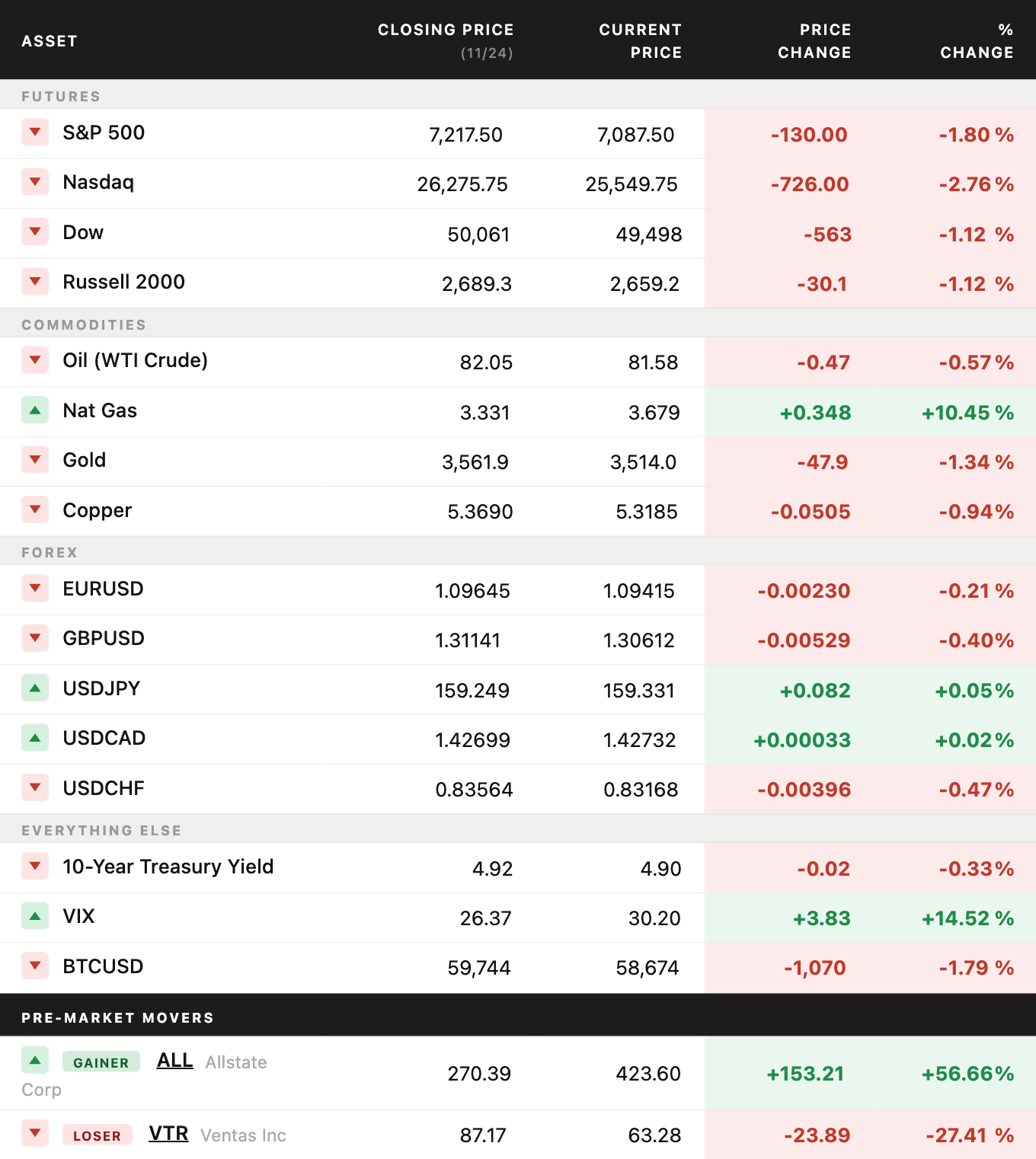
The AI Trade Moved From Demand to the BillTuesday split the market. The Philadelphia chip index fell 7.9% while the Dow rose 0.9% and closed above 50,000. Overnight, Korea's Kospi fell 6.2%, and a curb on program selling kicked in. Taiwan's market lost 4.8%, a day after its biggest point gain on record. The 10-year yield closed at 4.90%, down from 5.16% on Nov. 13. Yet CME FedWatch still puts a December hike near 97%. Bitcoin fell as low as about $58,400 overnight. On Polymarket, a bet on a drop to $55,000 this month rose to 35 cents from 27 cents Tuesday afternoon. October PCE is due before the open. It is the last big inflation report before the Fed meets. Market Implication Investors now price the cost of building AI apart from the wider economy. Lower long yields help steady Dow earners but do nothing for chipmakers' rising costs. If chips fall again while the Dow holds above 50,000, money is rotating, not leaving. WHAT ACTUALLY MOVED MARKETS Dell Booked Record AI Sales. The Stock Still Slid.Dell (DELL) posted revenue of $54.9 billion, up 103%. Forecasts were near $49.3 billion. AI server sales rose 291% to $22.0 billion. Its AI order backlog hit a record $132.3 billion. The stock fell 11.8% Tuesday before the report, rose after hours, then slipped again before Wednesday's open. Dell expects about $23.5 billion of AI server revenue this quarter, up only about 7% from last quarter. It aims for mid-single-digit margins on those servers. Its server and storage unit earned a 17% margin last quarter. Dell guided it to just under 15% this quarter as a strong North American mix fades, Bloomberg reported. It also sees memory prices rising into 2027. Structural Setup Dell settled the demand question, so the market moved on to price it. Each new dollar of AI server sales earns a thinner margin. Memory costs keep rising. That makes margin per server the number AI hardware now trades on. If Dell lands at its margin guide or better while memory costs rise, the selloff has run ahead of the earnings. Lenders Priced AI Borrowers Far ApartCoreWeave (CRWV) fell 11.8% Tuesday, and its bonds hit record lows. Its notes due 2032 traded as low as 74.9 cents on the dollar. The 2031 notes yielded more than 17% at their lows. Monday's relief over Jensen Huang's return barely reached credit, and Tuesday's drop erased the bonds' gains. Nvidia-backed Firmus, a private AI cloud firm, is weighing a $1.5 billion bond at roughly 8%, Bloomberg reported. At least two agencies rate the bond BBB. Bitcoin miner CleanSpark (CLSK) is funding an AI data center with $2.28 billion of secured notes paying 7.875%. Its finance chief said selling a bit more bitcoin than it mines is one way to cut risk. Sector Read Credit is sorting AI names by balance sheet, not by demand. CoreWeave's unsecured bonds yielded about 17% at Tuesday's lows. CleanSpark's secured notes and Firmus's rated bond sit near 8%. If the Firmus bond is pulled or prices well above 8%, even rated AI borrowers are paying up. I’m about to get into this Cybercab… and it’s going to take me to what Elon Musk called… “The most epic AI project ever.” Click here and come with me on this ride… Because this is all part of Elon Musk’s $320 trillion masterplan. New Tariffs Would Arrive as the Old Ones Are RefundedWashington plans to propose new tariffs on 16 trading partners, people familiar with the plans said. No notice is out yet. Rates could vary by country and would stay within caps in trade deals, Reuters reported. The caps include 15% for the EU, Japan and South Korea and 19% for Malaysia. They would stack on July's 10% or 12.5% tariffs. They would also partly replace tariffs the Supreme Court struck down in February. Refunds of those tariffs padded several retail earnings beats this week. Taiwan, Malaysia and Vietnam, key links in the AI hardware chain, are on the list. Watch Signal The refunds that lifted this quarter's profits will not repeat. The new tariffs would turn that relief back into cost. Stacked on July's levies, they would raise import bills just as refund gains roll off. That would make next year harder to beat for stores and hardware makers. If final rates exceed the deal caps, the extra cost lands hardest on chip suppliers on that list. Memory Is Being Sold From Both EndsSeoul sold the memory makers. Samsung Electronics fell 9.9% and SK hynix 11.1%, giving back Tuesday's gains. Goldman Sachs cut its price targets on both on Sunday. It expects common memory chip prices to fall about 20% in 2028. Ambarella (AMBA) guided this quarter's revenue to $70 million to $75 million. Last quarter it took in $115.2 million. Its CEO said soaring memory prices and short supply are making customers cancel or delay orders. Ambarella plans for memory to stay this tight into early 2028. The Read Both ends of memory are now priced for a turn. High prices are already cutting device orders. Lost demand is how shortages end. Ambarella's plan runs into the same year Goldman sees prices falling. If more chip designers cut outlooks over memory, that relief could come before 2028. Economic Data: October PCE prices, third-quarter GDP, durable goods and jobless claims, all before the open. Forecasts call for core PCE up 0.3% on the month and GDP revised to 3.5% from 3.4%. New home sales and the Beige Book follow. Markets close Thursday and close early Friday. Fed Speakers: Fed official Michelle Bowman gives recorded remarks on bank oversight. The Fed's quiet period starts Saturday. Earnings: Deere (DE) reported before the open. Overnight: Nikkei -2.8% | Shanghai -2.0% | Hang Seng -1.1% | ASX 200 -0.4% | Sensex +1.8% Nothing here says AI demand is fading. The market is pricing who pays: Dell's margins, CoreWeave's lenders, memory buyers and, soon, importers. October PCE decides whether the cost of money joins that list. The 10-year yield slipped again Tuesday even with a hike near 97% priced. If core PCE runs hot and that yield turns up, the Dow will have to hold 50,000 without help from lower rates. The Next AI Race Isn't About the Best Model.Models improve. Computing gets cheaper. An algorithm can be matched.
What's hard to copy is a company's own lab data: experiments run at industrial scale, with every result fed back to make the AI smarter.
In drug development, that loop may become the edge that matters most. Not who has the best model. Who can learn biology fastest.
We profiled 5 companies building that loop in a new FREE Special Report: AI Moves Into the Biotech Lab.
We'll text it straight to your phone. Get the Free Report by Text → |
|