


TQ Morning Briefing
Honeywell Aerospace fell hard on Thursday because a few of its suppliers cannot pour metal fast enough. The government counts heads at 8:30 this morning. Nobody at that company is short of heads.

Thursday looked calm from the index level.
The Dow gave back the most. The S&P 500 and the Nasdaq barely moved.
Energy led as crude jumped on the Iran headlines. Industrials lagged.
One name did most of that damage. Honeywell Aerospace (HONA) cut its outlook after Wednesday's close. The stock took the hit on Thursday.
Yields rose across the curve into this morning's payroll count. The front end moved most.
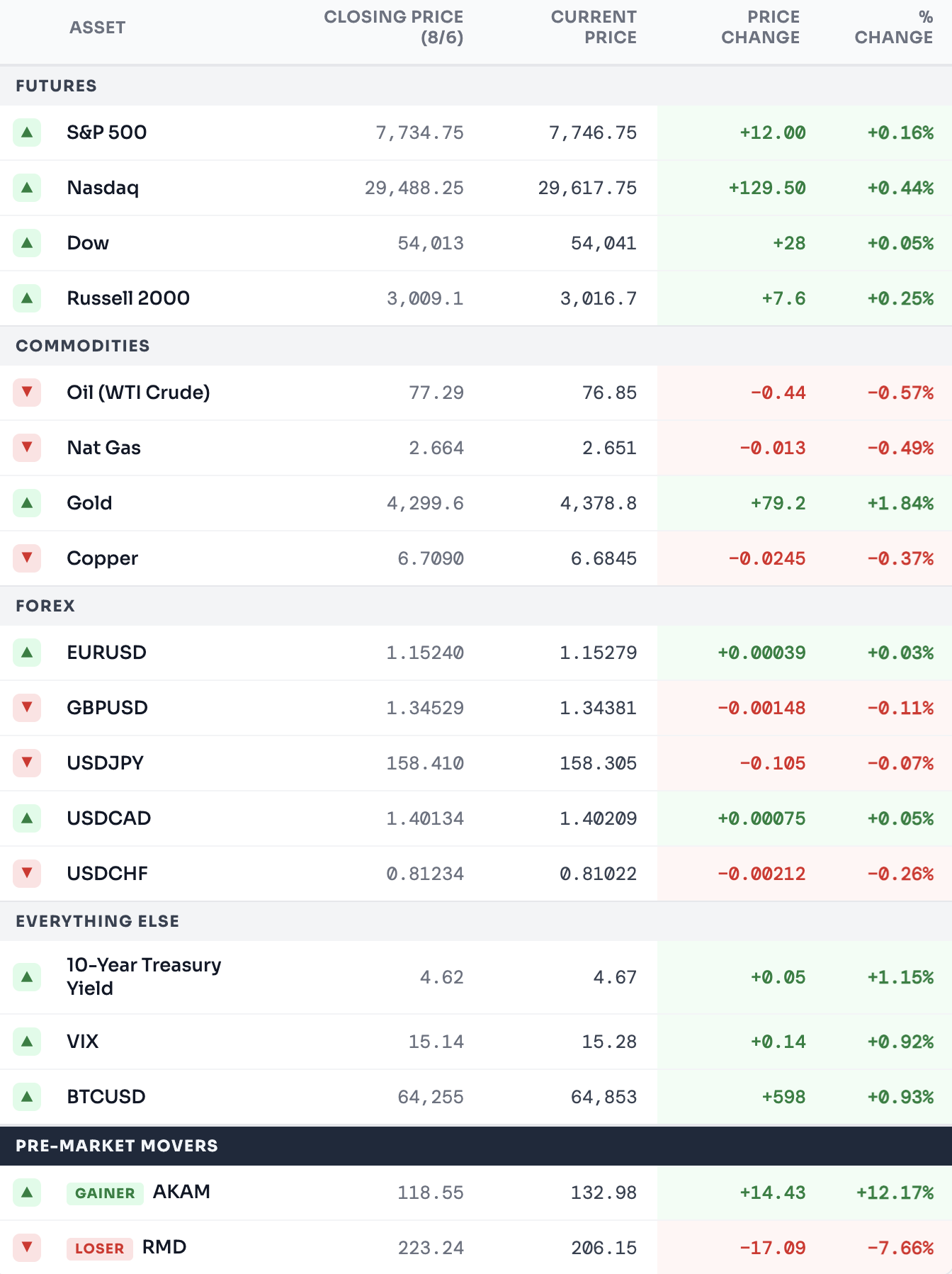
Stock futures are trading marginally lower. The ten year Treasury yield rose to 4.6%. The dollar is holding its overnight gains at 99.92. Gold closed Thursday at a seven week high and extended overnight .
Market Implication
The tape is positioned for a labor number. The week's largest single loss had nothing to do with labor. If a soft count cannot lift the industrial complex, the bid now sits with whoever holds physical capacity.
Watch What the Institutions Are Doing — Not What They're Saying.
Bank of America increased its stake in one small gold company by 139%.
Jane Street — one of the most sophisticated trading firms alive — by 159%.
Millennium by 122%.
One value fund, Kopernik Global, made it their single largest holding — owning roughly 8% of the entire company.
The company doesn't even mine. It owns the rights to an 88 million ounce deposit — one of the largest on earth — with government-built roads, power already running to the property, and permits that never expire.
Market cap: ~$4 billion. Value of the metal in the ground at today's prices: hundreds of billions.
The institutions did this math quietly, over months.
You get to do it this afternoon.
The shortage is narrow and it is everywhere.
Honeywell Aerospace builds jet engines and auxiliary power units. It cannot build either without cast metal parts.
Those parts come from a short list of foundries. Management said a small group of vendors caused the shortfall.
Those same vendors feed several product lines at once. So a narrow problem became a company wide guide cut.
The chief executive was forecasting strong growth in June. Two months later he cut the growth range close to half.
The metal is going somewhere else.
Casting capacity is full. What exists is being routed to new aircraft builds first.
That leaves the spare parts business short. Spare parts carry the fattest margin in the industry.
So the revenue that slipped was the good revenue.
Hiring cannot fix this. Qualifying a new aerospace foundry takes years.
Structural Setup
The market has spent two years treating labor as the input that binds. This guidance cut said otherwise. The squeeze is not on the payroll. It sits on the purchase order, and no policy rate reaches it.
Howmet Aerospace (HWM) pours the castings that go inside jet engines.
It reported on Thursday morning too, and raised its full year guidance.
Its engine parts unit grew revenue sharply and widened margin at the same time.
It absorbed several hundred net new people in a single quarter. The market is still short.
That is the tell. The bottleneck is physical. More workers did not clear it.
Its fastest growing end market last quarter was gas turbines. Management called that demand extraordinary.
A jet engine maker had cut its own guide the night before. Same chain, opposite directions.
The tape has already paid for this once. Apple (AAPL) posted its best demand in years last week and the stock fell anyway.
It could not build enough at the leading edge. Memory costs took what was left.
The market keeps pricing this one name at a time.
Sector Read
Watch whether the casters and the engine makers keep separating. Fluor (FLR) reports before the open. It now weighs supply chain capacity before taking a project. Castings, memory, turbines. Each of those chains narrows to a handful of names. None can be built quickly.
WARNING: A Major Market Shift Could Hit Stocks in 2026
If you have any money in the stock market, you may want to pay attention.
New research points to a massive market-moving event that could send hundreds of popular stocks into a sudden free fall.
Holding the wrong stocks when this hits could erase years of gains.
That’s why analysts have now identified a list of stocks investors may want to avoid as this event unfolds.
If you want to see what’s coming — and which stocks could be most at risk —
Tom Barkin takes questions at ten o'clock this morning. That is ninety minutes after the payroll count lands.
He runs the Richmond Fed. He also wrote the clearest recent Fed thinking on shortages.
In May he argued that raising rates does not touch the cause of supply driven inflation. His worry was what repeated shocks do to inflation expectations.
A closed shipping lane and a full foundry are the same thing inside that framework. Neither one answers to a policy rate.
The Committee held in July with three members wanting a hike. The next set of projections lands in September.
So the question he gets asked today is the one the market needs settled. How many separate shortages can a central bank look through at once.
Watch Signal
Listen for whether Barkin ring fences energy or treats every shortage as one category. Fold industrial parts in with oil and September stays a labor argument. Leave them out and a parts shortage becomes a rates input. The consumer expectations reading prints the moment he stops talking. He will not have seen it when he answers.
The alloy inside a jet engine blade also goes inside a power turbine.
Same metal. Same furnaces. Same short list of suppliers.
Turbine makers are booked out for years. Quoted waits on the hottest parts run past three. Some buyers hear longer.
That is the real gate on new electricity. The argument has been about permits and grid queues. The queue that matters is at the foundry door.
Vistra (VST) reports this morning and holds its call at ten.
It has gigawatts of new gas fired capacity committed in Texas. Those units land over the next few years.
The stock has lagged badly for a year. The usual explanation is a fight over power price caps.
That may be the smaller problem. Every megawatt in that plan needs blades. They come from the short list that just broke an engine maker's guide.
The Read
Guidance is the easy part of this morning's call. The in service dates are the hard part. A firm turbine delivery date is now scarcer than a signed data center contract. One of those can be negotiated. The other has to be waited for.
Congress to feature Trump on $100 Bill?

A shocking new plan was just introduced in Washington. The idea is to celebrate Trump’s new “golden age” by placing him on the $100 bill.
As you’ll see, it has little to do with the new Crypto Reserve…
Or Trump’s ambitious plan for Artificial Intelligence…
Former Presidential Advisor, Jim Rickards says, “Trump’s crowning achievement will be much, much bigger.”
In the months ahead, he predicts, the government will release a massive multi-trillion-dollar asset which it has held back for more than a century. And this will give ordinary investors a chance to strike it rich.
Economic Data: July Employment Situation at 8:30am ET, covering nonfarm payrolls, private payrolls, manufacturing payrolls, the unemployment rate, average hourly earnings, the participation rate and average weekly hours. Used vehicle prices for July at 9:00am ET. Consumer inflation expectations for July at 11:00am ET. Baker Hughes rig count at 1:00pm ET. Consumer Credit for June at 3:00pm ET.
Fed Speakers: Tom Barkin, Richmond Fed, fireside chat hosted by the National Association for Business Economics at 10:00am ET.
Earnings: Vistra (VST), Fluor (FLR), PPL Corporation (PPL), Plains All American Pipeline (PAA), Trimble (TRMB), Dillard's (DDS), Wendy's (WEN), Under Armour (UAA) before open | Take-Two Interactive (TTWO), Hawaiian Electric Industries (HE) after close.
Overnight: Nikkei -0.12% | Shanghai Composite +1.02% | FTSE +0.74% | DAX +0.82%
The report at 8:30 counts people. That has been the month's most important number for two years.
One guidance cut this week set a second question beside it. What if the thing holding output back cannot be hired?
Both get tested in the same session. One at 8:30. One on a utility call at ten.
Say the count comes in soft and the supply names keep beating anyway. Then the market has to price two economies at once.
One is short of workers. The other is short of metal.
Only one of them has a central bank.